Skip to content
Agentic AI · Pillar 02

An agent you can audit.

It acts at machine speed inside an envelope you wrote. High-risk actions wait for a person. Nothing goes unlogged.

{
  "decision": "revoke_idle_token",
  "actor":    "agent",
  "policy":   "nhi-envelope@v3 / machine_speed",
  "subject":  "svc-vendor-sync",
  "reason":   "no activity for 41 days (limit 30)",
  "evidence": "sha256:9f3a…c41e",
  "prev":     "sha256:71c0…08bd",
  "reviewer": null
}

Sample data. A machine-speed decision has no reviewer; a checkpoint decision names one.

Start with the limits

What the agent cannot do.

Autonomy is only trustworthy when its boundary is explicit. These limits are written into the policy model, and the agent runs inside them.

It cannot leave the envelope

Every action class is assigned a mode before the agent acts on it: machine-speed, checkpoint or human-gated. The agent cannot reclassify an action, widen its own scope or grant itself access. Changing the envelope is itself a human-gated, logged event.
POLICY-BOUNDVERSIONED

It cannot act unseen

Every decision, automatic or human, including the actions it chose not to take, is written to the ledger with a chain of custody as it takes effect.

SEALEDSHA-256

It cannot read your secrets in the cloud

Vault items are encrypted on the device with AES-256 and stay ciphertext in Sequrely’s cloud. Decisions are made on signals and policy, not on your secrets.

CLIENT-SIDEAES-256

It cannot delete, export or escalate alone

Deletions, vault exports, scope widening and access to systems you flag as critical are human-gated by default. The agent cannot move them out of that class.

HUMAN-GATEDBY DEFAULT

It cannot enforce before it has observed

The digital twin learns a baseline in observe mode first. Enforcement starts when you turn it on, per action class, not when the agent decides it is ready.

OBSERVE FIRSTOPT-IN
Autonomy policy spectrum

Low risk at machine speed. High risk through a human.

Three modes, assigned per action class. An example starting envelope.

Machine-speed within policy

Machine-speed

Reversible, low-blast-radius actions: ending idle sessions, rotating an expired share, containing an identity whose drift score crosses the line you set. Executed in seconds, sealed, reviewable.

EXAMPLE · END SESSION · ROTATE · CONTAIN
Checkpoint approve and audit

Checkpoint

The agent prepares the decision and the evidence, then waits. A named approver signs off in one tap before it runs. Just-in-time grants and new-device authorizations live here.

EXAMPLE · JIT GRANT · ADD DEVICE
Human-gated always a person

Human-gated

Deletions, exports, scope changes, policy changes and access to systems you flag as critical. The agent can recommend; only a human can execute. Nothing moves this class down.

EXAMPLE · DELETE · EXPORT · CHANGE POLICY
The decision loop

One decision, signal to sealed record.

Agents get twins too; theirs are tighter, because a deploy bot has no reason to be curious.

  1. Observe

    A deploy bot’s token is presented from a network it has never used.

  2. Score

    The twin flags token reuse plus new context. Risk crosses the envelope’s threshold.

  3. Classify

    revoke_on_token_reuse is a machine-speed action in this scope. No human is needed yet.

  4. Act

    The token is revoked and the credential rotated. The CI runner picks up the new secret.

  5. Seal

    Inputs, score, mode, action and actor are written and hash-chained. The security lead sees it in the ledger, not in a 03:00 page.

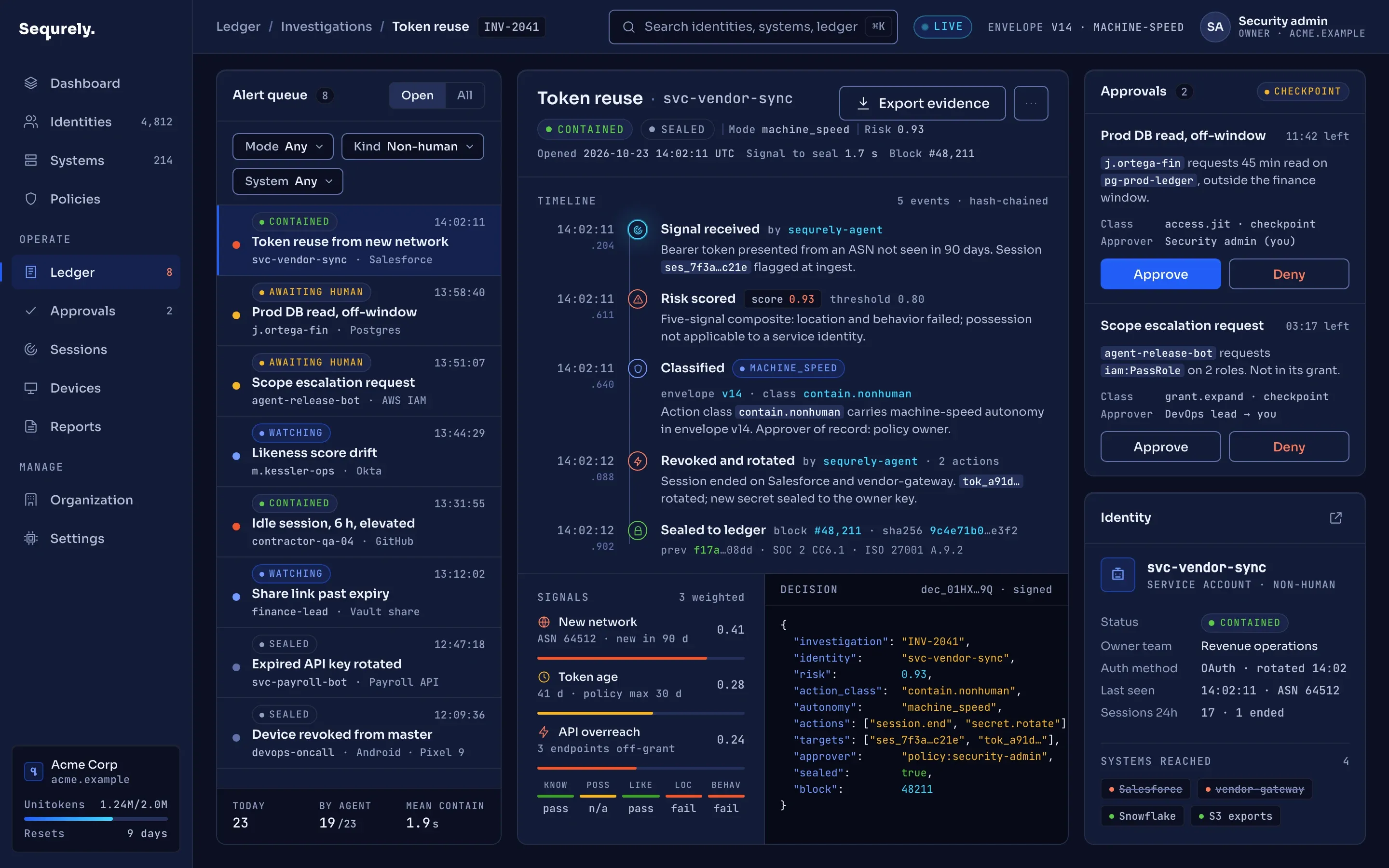
Sequrely admin console on the Ledger view: an alert queue of eight items with status chips on the left, an open investigation titled Token reuse · svc-vendor-sync in the center showing a five-step timeline from signal to seal, a weighted-signals panel and a signed decision JSON, and on the right two pending checkpoint approvals with Approve and Deny buttons and the identity's record
Sample data. The same decision in the SOC view: the alert queue, the five-step timeline from signal to seal, the weighted signals, the signed decision and the checkpoint approvals waiting for a person.
Investigation ledger

Every decision, in order, on record.

Agent and human rows share one ledger. That is what makes bounded autonomy inspectable.

Sample data: investigation ledger. Example row: 09:41:02, Sequrely agent, Ended idle session · svc-payroll-bot · idle 31m, status Revoked.

Sample data. Identifiers are fictional; humans are shown as roles.

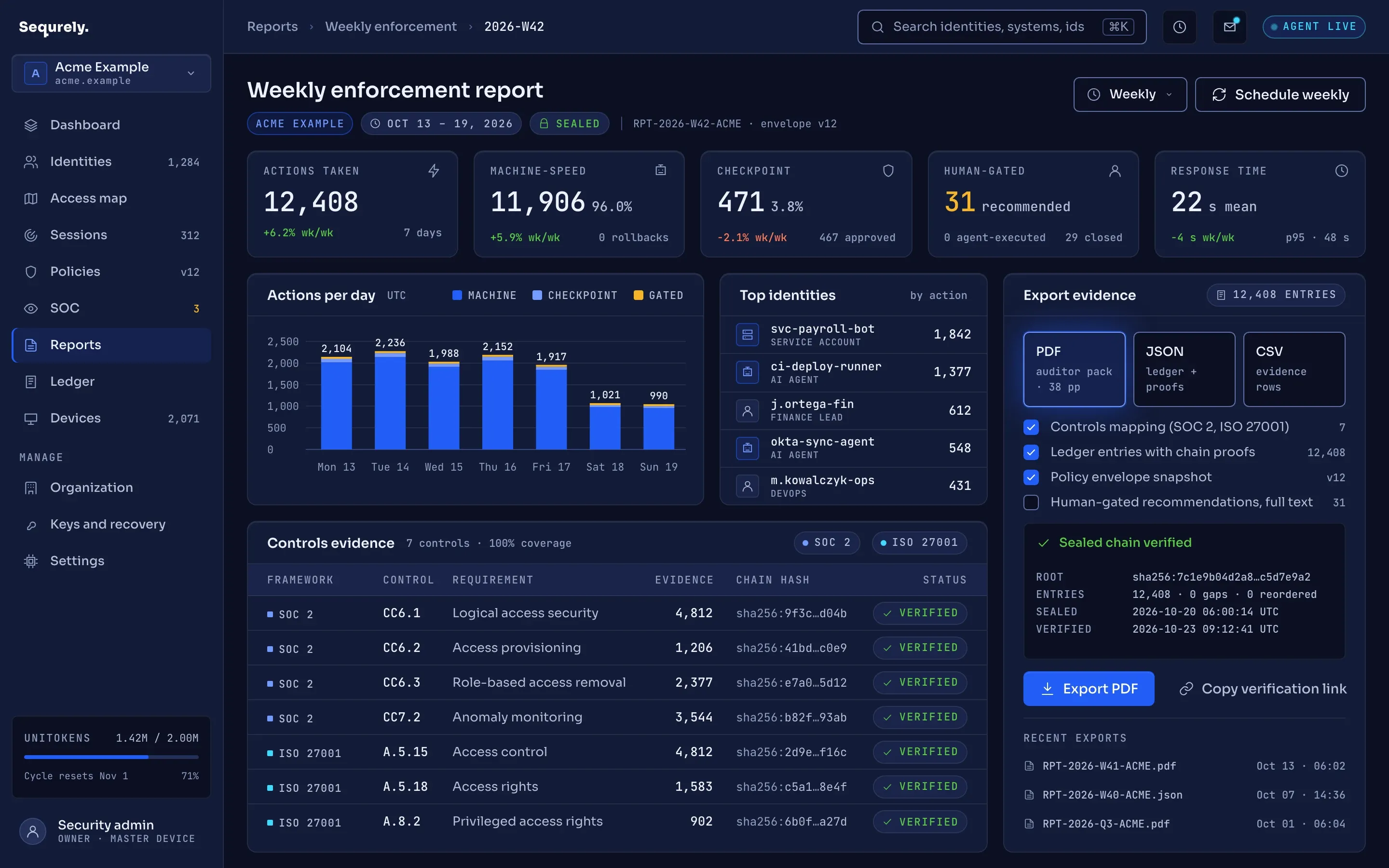
Sequrely admin console on the Reports page showing a sealed weekly enforcement report for Acme Example (Oct 13–19), with summary tiles for actions taken, machine-speed, checkpoint and human-gated counts and response time, a stacked bar chart of actions per day, a list of top identities by action, an export panel with PDF, JSON and CSV formats and a verified sealed-chain panel, and a controls-evidence table mapped to SOC 2 and ISO 27001
Sample data. Chain of custody: each entry carries the hash of the previous one. Edit a line and every line after it stops verifying. The weekly report exports the chain as evidence for SOC 2 or ISO 27001 controls, with the seal verified before it leaves.
Machine speed

Built to respond in seconds.

Targets the enforcement engine is built to meet.

Time to respond
22sec
from hours
Manual investigations
−85%
fewer routed to people

Targets the enforcement engine is built to meet, measured on sample estates.

Set the envelope.
Read the ledger.

Low-risk decisions execute at machine speed. High-risk actions always route to a human.